Last night:
Me, to Mingo: “No! Cats may not walk through the Ragu.”
Arthur, from next room: “The cat’s walking in the Ragu?”
Me: “The important point here is that the Ragu is in walkable position.”

Last night:
Me, to Mingo: “No! Cats may not walk through the Ragu.”
Arthur, from next room: “The cat’s walking in the Ragu?”
Me: “The important point here is that the Ragu is in walkable position.”
Having a blog and finding yourself with absolutely nothing to say. So, here’s a mini-linkfest:
I am outraged by this.
I found a blog dedicated to what may well become my favorite new show. What did I think of Studio 60 on Sunset Strip? Well, it was a very engaging way to introduce a series, but as an individual episode, it was not an act of genius. Can’t stand next to the pilot for The West Wing. I agree with the Sunset Strip blog; B+ seems about right. Bradley Whitford’s character is intriguing. Very. I wasn’t one of those Josh-crushy girls for West Wing, but Danny Tripp could definitely get crushy.
Jason at Wild Hunt has been knocking them out of the park all week. Four (count ‘em) posts on the complex relationship between Pagans and Unitarian-Universalism (start here) with lively comments, and then a smart look at the religious nature of Halloween, from both Christian and Pagan perspectives.
One of the “quarter of one” guys gave me a document to edit. The document describes how a software system works. The paragraph in question describes the tables associated with setting the page size (scrolling area) in the system.
When the user saves a page size
[The table] PaginationDetails gives previously saved page size (if any) and if not then insert given page size and if any saved page size is there then update it with given page size.
Seriously. I had no idea what this said. None.
After meeting with the author, the following is the final paragraph:
When the user saves a page size
• PaginationDetails: if there is no previously saved page size preference, then a new page size is inserted into the table PaginationDetails. If there is a previously saved page size, then the old size in the table is updated with the new size.
Brick (2005) 10/10
Brendan (Joseph Gordon-Levitt) is contacted by his ex-girlfriend, desperately seeking his help. He re-enters his former world of dope sellers and criminals, hoping to save her and himself.
You know what you don’t think when you hear that such-and-such a film is a modern film noir? You don’t think it’s a film noir. Seriously. You think it’s got a certain style, a darkness, an edge. You expect, perhaps, particular costumes or a particular tone to the dialogue and the slang. But you don’t expect it to really be film noir.
Brick is film noir. Is. Brendan is Sam Spade. Or maybe Philip Marlowe, because he’s smarter than Spade, but no, he sounds like Spade and thinks like Spade and there’s no doubt in my mind that Laura (Nora Zehetner), from the moment she appears on-screen, is Brigid O’Shaughnessy.
Except that Brick is set at a present day high school.
In a way it makes perfect sense. Noir is a perfectly valid lens through which to view high school: The social circles that barely know each other, the seamy underside hidden from the clueless authorities who think they understand, the back alleys, basements, and parking lots in which teenagers live parallel to, but not quite a part of, the rest of the world. The slang that changes as it goes along, because the whole point is to make sure no one else understands. Noir reads like high school, and high school reads like noir, with its heightened emotions; with big love, big betrayal, and enormous danger.
Most of the young cast is excellent, although Zehetner is a bit weak. Gordon-Levitt gives us a hero who is by turns as tough and smart as he looks, and then is a vulnerable, frightened kid who is faking tough and smart as best he can. Who is totally over the girl from before, and who will live and die by the hope of getting her back. His face is infinitely watchable, and the director knows it, providing a lot of close-ups; indeed, his face is so nuanced and fascinating that studying it furthers the plot. Lukas Haas has a killer supporting role, by turns frightening and funny.
This is definitely a low-budget indie, but first-time director Rian Johnson turns that into an advantage in exactly the way that the original low-budget noirs did: Empty landscapes, hollow halls, blank rooms, that seem to say that there is nothing here but the mystery, nothing but the love and loss and violence. The only real problem with the low-budget nature of Brick is that the sound is kind of fuzzy and some of the rapid-fire dialogue is hard to make out. Thank goodness for DVDs, huh?
Two Ukrainians at work having an argument and come to me to solve it.
“Deborah, does ‘a quarter of one’ mean 1:15 or 1:45?”
“It means 12:45.”
“Oh, okay.”
|
You Are Big Bird |
 Talented, smart, and friendly… you’re also one of the sanest people around. You are usually feeling: Happy. From riding a unicycle to writing poetry, you have plenty of hobbies to keep you busy. You are famous for: Being a friend to everyone. Even the grumpiest person gets along with you. How you life your life: Joyfully. “Super. Duper. Flooper.” |
Tom tagged me with this evil bit of humiliation. Name five songs that make you cry and explain why.
The humiliation part is that I am a total sap. A sappy sap. And the songs that make me cry are sappy songs. I am not one to have guilty pleasures, I will gladly tell you my favorite schmaltzy movie or corny TV show, but the songs? The songs are a genuine red-faced guiltfest.
And here they are.
Roberta has some great musings about quitting smoking. (I kicked in with some comments.)
I have long mulled the issue of smoking-related illnesses. Why don’t the threats of cancer and heart disease and emphysema have more impact on people? Why do we persist in smoking? One of my very best friends is a cancer survivor who still smokes (and when I was a smoker, I held her up as a role model whenever people nagged me).
In our modern Western culture, we fear death, not mostly as the end, but as the unknown. And I don’t mean, “What happens when you die?” as in, afterlife, reincarnation, white light. I mean as in, what does it look like, smell like, sound like. Death is away. In the hospital or hospice, in the slaughterhouse, at the vet’s, not at home or in the yard or on the farm or in our arms.
So when the threat of cancer is dangled before us, it’s just one more scary ghost in the haunted house. Not scarier than our general sense of the end of life as unknown, possibly terrifying, and probably painful. Isn’t that what we think anyway? So why is cancer actually worse than that?
It’s interesting that when most people talk about being influenced by the threat of cancer, they talk, as Roberta does, about witnessing cancer with their own eyes. (My friend, by the way, had a quick diagnosis and successful surgery, no chemo or radiation, so she skipped many of the gruesome experiential features.) Without that witnessing, that confrontation, that face-to-face this is IT I’m not scared of the unknown I’m scared of THIS, it isn’t motivating. Being scared of something real and specific is motivating, being scared of a general malaise of unknown terror just makes us shut down and deny. Which probably relates to why Bush’s constant terror-mongering is not working, but I digress.
So part of the solution feels like getting real. Not about smoking, so much as about life, death, and disease in general. Only then can we see smoking in the context in which it belongs.
This is a re-run of the disappeared Kittenblogging from last week.
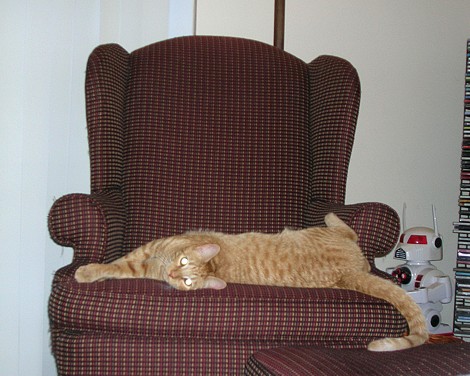
Notice how his tail is resting on the footstool. That’s just very cool.