Got it from Shakes, but this is the link to read.
Short version? The big telecom companies want to control what you can see on the internet. We don’t want that!
Go here.
Sign the petition.
Write your Congressperson.
Got it from Shakes, but this is the link to read.
Short version? The big telecom companies want to control what you can see on the internet. We don’t want that!
Go here.
Sign the petition.
Write your Congressperson.
Saturday was Blog Against Heteronormativity Day. I didn’t participate. I live with a great many complex thoughts about gender and orientation, and I suppose if I had simply sat and written some thoughts, it would have turned into a decent essay. But I was put off by the big, self-important neologism, and a little put off by all these blogosphere Day designations as well. Also, I’m not comfortable with all this defining; I’m not convinced that gay, straight, and bi are enough categories, or the right categories.
So, last night, I saw the wonderful movie The Station Agent. In it, a dwarf (Peter Dinklage) struggles to be treated as himself, and not as an oddity. Fin (Dinklage) says “It’s funny how people see me and treat me, since I’m really just a simple, boring person.”
So I realize; it’s not heteronormativity, it’s normativity. » Read more..
The Outlaw Josey Wales (1976)10/10
When Josey Wales’s (Clint Eastwood) wife and child are killed, and farm burned, by Union soldiers (Kansas Redlegs, to be precise), he joins the Confederate army (Bill Anderson’s Missouri Bushwackers). When the war ends, he refuses to surrender, and becomes a wanted man, bent on vengeance. As he journeys, he draws to him a band of other disconnected outsiders. Directed by Client Eastwood.
The Outlaw Josey Wales is complex and layered. It has multiple levels of symbolic meaning, but is never heavy-handed—it ain’t Pale Rider, hammering its Important Meaning home.
Look at this: Josey Wales is an iconic Western hero. He poses in perfect symmetry with the landscape, with the hardened, iconic face of Clint Eastwood, he’s the best shot in the West and his only goal is vengeance. But look at this: In the end, Wales sues for peace with the local Comanche chief (the wonderful Will Sampson) and agrees, with his pursuer (John Vernon) that they will put the war behind them and give up their mutual quest.
As Lone Wattie, Chief Dan George has primary charge of busting the Western myth. When Lone Wattie pronounces something with gravity and wisdom, he is generally proven wrong. He is neither a buffoon nor a noble savage, but an aging man who wishes, ruefully, that he could live up to the white man’s image of the Indians. And he’s pretty funny, too.
Everyone in this film has images that will be busted. Kansan Granny Sarah hates Missourians, but must trust Missourian Josey Wales. Little Moonlight is marked with the Cheyenne sign of the “dirty nose,” but it means something different than it appears to. Laura Lee (Sondra Locke) is thought to be “odd” but holds her own. In wartime, everyone has painted the enemy in broad strokes. To live in peace, each person must learn to see individuals. No one says this, gives a speech about it, or even notices it, but it’s an observable part of the arc these characters take.
The theme that touched me the most when I first saw this movie was that of created families. Josey Wales draws to him a group who have nothing but their wounds and their loss. Like Josey, each has lost family, is cut off from home, and has no way of restoring his or her pre-war life. The Indians in the film are even more displaced than just being Indians would make them. By coming together and creating their own family, they can heal one another. This is a theme Eastwood will return to in myriad forms (Bronco Billy is a comedic version).
In addition to all of this, IMDb commenter A-Ron-2 points out that the movie serves as commentary on the end of the Vietnam war, an idea I had not previously explored. It is especially interesting when you learn that the Redlegs and Bushwackers fought a guerilla war, making the parallels to Vietnam even more stark.
In the early seventies, there was a law that sensitive teenage girls had to be Joni Mitchell fans. And I’m nothing if not law-abiding. Actually, I’m many things if not law-abiding, but this was more like a law of nature. Like gravity or the phone ringing as soon as you sit down to eat.
Anyway, by the late seventies, Joni was changing her style and losing the top of her vocal range, and most of her fans were abandoning ship. 1976’s Hejira was the last album I heard get any radio play until the late nineties.
The turning point for me was Hejira; the first Joni Mitchell album I didn’t buy. A lot of fans jumped off one back, and didn’t buy Hissing of Summer Lawns, but not me, I loved that album. Loved it. Loved. It. There were songs I didn’t like as much as other songs, but I still played its little vinyl grooves to death.
So from time to time, I purchase old vinyl favorites on CD, and not long ago Hissing of Summer Lawns got the upgrade. Alas.
Listen, Don’t Interrupt The Sorrow is still a flippin’ great song. Great. But it’s early (track 4) and I’m listening to the whole CD while writing, and after a while I think “This is pretentious.” And then I think “This is way pretentious.” And then I think “This is shit.”
Ah, the heartbreak. I tell you, right now I am afraid to pull out any other old favorites.
(Cross-posted at If I Ran the Zoo. Just cuz.)
I recently finished All in Good Time by Jonathan Schwartz. I have been listening to Schwartz on the radio all my life (quite literally, as my parents listened before I was old enough to remember) so the memoir interested me, and it didn’t disappoint.
This post, though, isn’t primarily a book recommendation. Reading All in Good Time brought me up short on the whole concept of the memoir. The book is raw and open. Not in the conventional, might-as-well-be-true manner of James Frey, but in a much more personal, much more revealing manner.
In a memoir, anyone can be honest about their alcoholism (and Schwartz definitely is). To reveal your first drink at age ten, to chronical checking into the Betty Ford Center in a moment of desperation, these are facile revelations that function as the memoirist’s stock in trade.
No, I’m talking about shame. Humiliation. Being a braggart and getting called on it. Hurting a friend with a casual lie and getting caught. Meeting your hero and sticking your foot all the way down your throat until you can kick yourself in the esophagus.
I was stunned by the honesty of these revelations, and moreover, by the absolute impossibility of me ever pulling off such a feat. I’m a very blunt person, the undisputed Queen of TMI. My role in life is to go there when people say “don’t go there.” But reading All in Good Time, I knew I could never be that honest in print, in public, with (as they say) God and everyone watching. Geez Pete, I’ve written five books, and even with the impersonal stuff of spells and elements, readers are happy, nay, gleeful, to rip you a new one. Tell them my mistakes? Oh the pain.
The. Real. Goddamn. Pain. I’ll tell you the truth right now: I could never write like that without cleaning up my act. Without tidying the messes, without making me look just a little bit better than I really was. I wouldn’t know how to bear the suffering of it otherwise, and I don’t know how anyone else does.
(Cross-posted at If I Ran the Zoo. Cuz Tom’s a fun guy.)
I was just in a meeting, and I felt myself nodding off, and I thought “I’m pulling a Cheney.”
Probably, pulling a Cheney will someday mean shooting a friend in the face, but falling asleep in an important meeting is certainly a contender.
If you don’t know me, allow me to tell you that I am coated in tattoos. My left arm from shoulder to mid-forearm is all florified. My right arm has a big 9/11 memorial. So around this time of year, when I start wearing sleeveless tops, I get remarks.
So the new guy at work sees me in the lunchroom.
“Hi” he says. (He’s never said hi before.)
“Hi.”
“So, you like tattoos?” (No, hate ’em. I’m wearing them as a form of masochism. Here’s your sign.)
“Yes.”
“Is that the World Trade Center?”
“Yes.”
“Do you change them around sometimes?” (Oh. My. Gods.)
“No, they’re permanent.”
“Oh.”
It went on, but that was the fun part. For variant definitions of fun.
(Cross-posted at If I Ran the Zoo.)
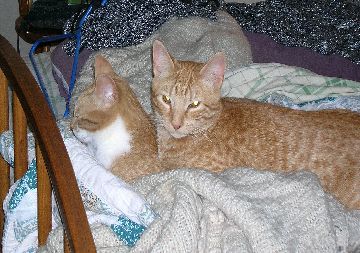
The Gang of Two are now six months old, and experiencing the last two weeks of functioning reproductive organs. Should I cease kittenblogging and become a catblogger? I await your verdict.
Two-headed kitten
» Read more..
Of all the reams of material I’ve read about the Duke rape case, the raw news, the feminist, race, and class analysis, the anti-feminist rhetoric, the information on DNA testing, the meta-news about how the news is reporting the story, of all of it, the thing that resonates most clearly for me is the car theft analogy.
Sometimes people who report their cars stolen are lying, for their own reasons, be it fraud, malice, attention-seeking, or whatever.
Sometimes, a person consents to loan his car, and then accuses the borrower of theft. Such a case is ‘one person’s word against the other.’
Physical evidence of damage to the car isn’t proof of theft. It might merely prove vandalism. If I break your car window, and then someone else comes along and jacks the stereo, I am not a thief, am I? I’m just a vandal! Nonetheless, such evidence is considered significant.
Although there are numerous authorities advising you on how to avoid getting your car stolen, your lapses in following that advise aren’t all that pertinent to the theft investigation. If you left a package visible in the car, or if you parked on a dark side-street, your right to file a theft report would not be questioned.
Some car thiefs are joy-riding youngsters, often alcohol-fueld, and with no criminal background. This doesn’t prevent the theft from being treated as a crime, nor does it shift blame onto the victim.
So this morning I hobble slowly downstairs. Because it’s the beginning of spring and my feet aren’t used to any of my spring shoes yet. And I get to the car and discover I forgot my keys. How can I forget my keys? So I hobble back upstairs. And halfway up I discover that there is the stinky stink of a cat who recently did the poo thing. So I clean the cat box and then go back downstairs with more facility this time (practice). And I get to the car and discover I have no keys. Now, to be honest, I am worried about my brain. So back upstairs, and I realize that there is a piece of paper—the schedule for Arthur’s dance recitals—inthe basket by the door, covering the keys.
So this is what has become of my brain. Out of sight out of mind is now literal.