Last minute save by Ben meant no hints needed and everything is now solved.
Archive for Deborah Lipp
Envy of biological power
Today at Shakesville, Brynn posted about the idea of womb envy.
do you think the principle that femaleness is the default and maleness a Johnny-come-lately to the biological scene, operating on a very deeply subconscious level, fuels the fear and hatred of women that leads to brutal stonings and rape, not to mention, a near-universal inequality and subjugation of women throughout the world?
Brynn was riffing on a scientific article about the discovery of partheogenesis in sharks.
My thoughts: I don’t think it has anything to do with partheogenesis, really. I don’t think human beings have any innate subconscious fear of virgin birth. Mythologically, it’s a Johnny-come-lately, and always very benign and very blessed. Buddha, Krishna, Mithras, all virgin births, all saintly males. The stories are low-stress and the women in them are all pretty much “in their place” (under the bo tree and pregnant).
But I do think womb envy is at the deepest root of misogyny. Plus, you know, a lot of complex Oedipal stuff. The mythology about menstruation, female sexuality, and female power is considerably more fraught with anxiety and tension.
Basically women have power—biological power in the form of childbirth, lactation, and the magical blood thing—and men are dependent on them from boyhood, men are envious and terrified, men fear and hate their own dependency, therefore the only solution is to usurp power and treat women as if they have none.
It’s the run-on sentence of all human culture.
Tuesday Trivia: Late Day Edition
1. A man runs across a busy highway because he is convinced that it is fake and the drivers are stunt drivers who won’t hit him.
Solved by George (comment #4).
2. Brain damage turns a “bleeding heart liberal” into an arch-Conservative.
Solved by George (comment #4).
3. A minister is discomfited when he enters an artist’s studio and finds nude models.
Solved by Karen D (comment #1) and shortly later by Roberta (comment #2).
4. A baby is named after the three strangers who helped deliver him.
Solved by Melville (comment #7).
5. A roomful of “Apathetics” staring off into space and not moving.
Solved by Melanie (comment #9).
6. A shirt that matches the bathroom walls.
Solved by George (comment #4).
7. She holds her robe open to let her boyfriend look at her body, but only for a set period of time.
Solved by Ben (comment #10).
Fixed!
I have a working computer. I’m kind of swamped, so Tuesday trivia may not go up until this evening.
Monday Movie Review: The Last King of Scotland
The Last King of Scotland (2006) 8/10
Young Scottish doctor Nicholas Garrigan (James McAvoy), seeking adventure, decides to work in Uganda in 1971, arriving just as Idi Amin (Forest Whitaker) takes power. Through a chance meeting, he is invited to become Amin’s personal physician, and eventually becomes deeply involved in Amin’s inner circle.
Late in the movie, a character urges Garrigan to return to Europe and tell the story of what’s happening in Uganda. “People will listen to you,” he says bitterly, “You’re white.”
The character is, of course, pointing to the “othering” of Africa. It is full of black people, and so white people in Europe and North America pay little attention, no matter how severe the problems are. This certainly isn’t confined to the 1970s—think of how few people in the U.S. knew about Darfur until quite recently. Yet how can such a line of dialogue be allowed to stand in a movie that does exactly what it claims to be bitter and weary over? The Last King of Scotland takes the compelling story of the Presidency of Idi Amin Dada, and tells it through the lens of a fictional white person.
(Historical notes: This IMDb post suggests that Garrigan is a composite of three historical characters; Bob Astles, Mbalu-Mukasa, and an unnamed Scottish doctor, as well as the then-Minister of Health. Wikipedia, on the other hand, refers to Garrigan as a fictionalized Astles.)
The movie cannot overcome this conundrum. It wants to tell the white European version of the story, while criticizing that there is a white European version. Further, Garrigan is fundamentally ignorant of what’s going on around him. He wants to see the world, to philander, and to get laid. Which is fine, if that’s the way you’re going to draw the character, but it’s also a limited point of view. The audience isn’t told exactly what Amin is doing until Garrigan is told, and in this case (unlike in most movies), the audience is actually more ignorant. Garrigan is asked “Do you know what’s going on in this country?” and replies “Some of it,” but we know none of it (except what we may be bringing to the table apart from the film). Amin’s crimes against his people are told all in a rush, a whoosh of information and atrocities meant to shock without really informing.
Is Garrigan a symbolic character? Does he represent “Europe” or “the whites” or some such concept? Maybe, but the script doesn’t really seem smart enough to have thought it through that far.
As Amin, Forest Whitaker is hypnotic and fascinating. He is like a toddler walking around with a loaded gun, so damn friendly, so damn scary. McAvoy also does a great job in a demanding role.
By the way, this movie is a testament to the need to overhaul the Oscar nomination process. McAvoy is a textbook lead; the movie is told entirely through his character’s eyes. Whitaker is a textbook supporting actor, he has a strong presence in the movie, but his primary role is to have an effect on McAvoy. Yet Whitaker won Best Actor, not Best Supporting, and McAvoy was overlooked entirely.
I really do hate computers
My computer started turning itself off. We’re replacing one part at a time, trying to see what’s causing it. I mean, first we took out and cleaned the fans. And when that didn’t work I felt like we had to keep trying because now I have the cleanest computer in downstate New York. And then we replaced the power supply (because Gary had a spare) and then we took out the floppy drive (which didn’t work anyway), and then we fooled around with the power switch.
So the only thing left is the motherboard, which is scheduled for replacement tomorrow, and if that doesn’t work, it’s rebuild the whole thing.
Obviously, this interferes with blogging. I’m writing from the library right now. I don’t know if you’ll get a Sunday Meditation. Bear with me.
Jews! Funny!
Almost a year ago, I blogged about the presence of Jews on TV. I am reminded of this because of the May 3 episode of ER (which I watched a few days ago: Tivo is God, praise Tivo).
In the episode “I Don’t,” Luka arranges a surprise wedding for Abby (seriously, have these people completely run out of ideas?). He has managed to get the dress she was lusting after in a bridal magazine, and gotten her measurements so he could have it fitted, and picked the flower arrangements she’d been idly admiring, and so on. Everyone at work shows up for what they’ve been told is a departmental dinner, conveniently dressed in wedding attire (I am starting to hate this show).
And in a moment of hilarity! The Justice of the Peace is sick! And a rabbi! That’s right a rabbi! Fills in to perform the ceremony.
I just. Couldn’t. Believe it. My jaw was just dropping. The rabbi (played by George Wyner) was a caricature more suited to the 1950s than 2007. He was there for no reason except Jews Are Funny. He said “meshugga”—Funny! He had a Yiddish accent—Funny! After marrying two gentiles he asked the groom to step on a glass and said “Humor me”—Hilarious!
I was so offended my skin just about crawled off my body. He did everything except ask for money (because Jews! Like money!) and offer to circumcise Luka.
Based on last names alone, episode writer David Zabel and director Andrew Bernstein are Jewish, so I am baffled at this ill-considered and kind of creepy display of kitsch anti-Semitism. But I assure you, it was sickening.
Mystery
I was talking with my sister about relationships, and I mentioned that there was a passage from an Indigo Girls song that I thought encapsulated a lot of what we were discussing. And I opened my mouth to quote it and…
Nothing.
A complete blank. So then I tried to paraphrase. Nothing. Mush came out of my mouth. Pure mush. I couldn’t come up with a single line, or the basic meaning, or the name of the song or the album or anything.
So this morning I finally remembered enough of a passage to do a search. The song turns out to be Mystery from Swamp Ophelia, and the passage is:
So what is love then,
Is it dictated or chosen?
Does it sing like the hymns of 1000 years,
Or is it just pop emotion?
And if it ever was here and it left
Does it mean it was never true?
And to exist it must elude
Is that why i think these things of you?
So yes, I think that encapsulates most of the questions we ask about love. It doesn’t, however, encompass the questions I have about what’s happening to my frickin brain.
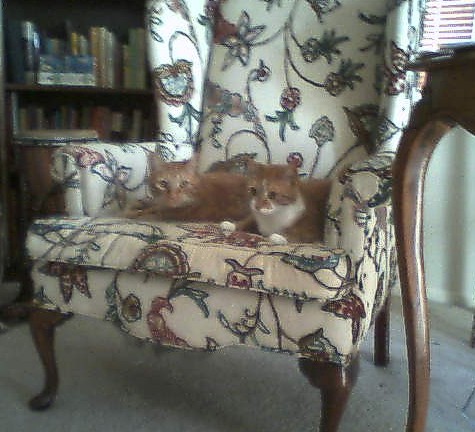
Friday Catblogging: Very Alert
Roberta took this picture with her camera phone, so it’s a little fuzzy, but it’s really cute and I’m having computer problems that prevent me from loading other pictures right now.
Costume Trivia Solutions
One that I thought was an absolute gimme went unsolved. And someone other than Tom solved #5. An unpredictable week.