Archive for Deborah Lipp

Tuesday Trivia: Relationships

Name the actor by figuring out the relationships (each from a different movie).

1. Daughter of Barbara Harris. Mother of Tom Felton. Sister of Rob Lowe.
Solved by maurinsky (comment #8).

2. Father of Seth Green. Brother of Jeff Bridges. Husband of Sally Field.
Solved by Melville (comment #6).

3. Husband of Julianne Moore. Uncle of Barry Gordon. Boss of Dustin Hoffman.
Solved by Melville (comment #4).

4. Wife of Christopher Walken. Employee of Yaphet Kotto. Lover of Christopher Reeve.
Solved by Evn (comment #5).

5. Lover of Christopher Reeve. Rival of Laurence Olivier. Employee of Christian Bale.
Solved by Evn (comment #1).

6. Employee of Hugh Grant. Niece of Stockard Channing. Daughter of Ellen Burstyn.
Solved by Evn (comment #1).

7. Father of Teresa Wright. Husband of Janet Gaynor. Fiance of Susan Hayward.
Solved by Melville (comment #4).

Monday Movie Review: 3:10 to Yuma

3:10 to Yuma (2007) 10/10
Rancher Dan Evans (Christian Bale), desperate for money, agrees to join a group of gunmen bringing notorious outlaw Ben Wade (Russell Crowe) to justice. They’re riding to Contention, Arizona to put Wade on the 3:10 train to Yuma prison. But Wade’s gang is still free, Wade himself is dangerous, and the road to Contention is fraught with hazards.

What does it take to be a great Western? What would it take to make you want to see a Western made in 2007—a remake no less? For me it starts with mise en scenè; the cinematography, production design, costumes, and actors have to conspire to make it feel real. I’ve got no use for a fake Western—a bunch of goofy actors playing dress-up and fooling around with guns. Make the characters interesting; the world you’re showing me is hard, so let me see what hardening has done to people. There will undoubtedly be action, so film it well and make it exciting. Story counts, and since actors do love to play dress-up, give me talented people whom I’m interested to see in this context. Add a good script with a clear narrative that holds some surprises, and you’ve got me.

3:10 to Yuma delivers on all counts, and then exceeds any expectation I brought into the theater.

Let’s start with the main characters. Bale and Crowe are equally the leads, each with a significant and compelling character arc. As they travel together—the classic reluctant road trip, a staple of comedy and drama alike—they discover a commonality. Each is clear he is nothing like the other; Evans is moral, a good husband and father, rooted in his ranch, while Wade is straightforward about his own evil; “You have to be rotten,” he affirms, to do what he does. Their moral difference honestly separates them and is not prettied up, but their intelligence and dignity draws them together, because here are two men set apart from the worlds in which they live. Evans is smart, insightful, thoughtful; he is better than the moneylender who is close to destroying him, than the drought which has brought him low, than the ranch hands he can’t afford to hire. And Wade, pensively sketching nature and quoting Proverbs, lives in a world of thought and imagination that neither criminals nor Pinkertons can touch.

Each man is introduced in a way that paints a vivid portrait. We start with Evans; a sound in the night alerts him, and he’s awake, armed, terrified, enraged, and helpless while thugs burn down his barn. His face in the firelight says it all. Then we move to Wade, still and relaxed on horseback, sketching a bird until his gang comes to tell him they’re all ready for the brutal robbery that begins the film’s action. He leaves the sketch behind, on a branch. Now we know these men.

There’s a level at which Ben Wade is monstrous; “He’s the devil” the friend I saw it with said. Played with quiet good will by Crowe, he seduces everyone around him with his words; asking questions, probing, seeding doubt. At the same time, he’s immensely powerful; unarmed and in handcuffs, the marshal of Bisby is clear that five guards are not quite enough.

Like most Westerns, 3:10 to Yuma is extremely masculine, but the two women with speaking roles are treated with an unusual level of respect. (As an aside, there’s an extra in one of the towns, a whore leaning up against the wall, who seems convinced that this is her Big Break. She’s blurry and in the background, and acting her heart out. It’s pretty funny.) Neither Alice Evans (Gretchen Moll) nor the barmaid (Vinessa Shaw) are clichés; they aren’t stupid or objectified or whores or madonnas, they’re people.

Actually, the film is populated entirely by people. Few are stock players. Small roles played by Peter Fonda and Alan Tudyk, for example, seem rich; these are individuals, not just whoever is on a horse with a gun.

The movie isn’t afraid to make us laugh, but it’s deadly serious. It is in many ways conventional, but unexpected things occur. The sense of place is solid; you know where you’re going and how you got there—I find that lacking in many movies, where I often feel lost.

There’s a brief love scene between Ben Wade and the barmaid that encapsulates everything that can go wrong with movies, and goes right with this one. These quickie seductions are usually too brief, or too dirty, or too chaste, or too mean-spirited, or in any of a dozen other ways, too unbelievable, and stuck there because movies need sex. But this scene…wow. It has context, meaning, and real seduction. When he comes closer to her she is ready, when he touches the back of her neck, she is startled in exactly the right way, and receptive in exactly the right way. It was sexy, and it was touching.

The whole film is like that, side-stepping a thousand wrong turns and making right ones, again and again and again.

Sunday Meditation: Rosary

Having been raised Jewish, I had no familiarity with a rosary until I began to study Hinduism, where it is called a mala or a japa mala. In Buddhism, they are known as juzu or nenju. A mala generally has 108 beads, an auspicious number in Hinduism and Buddhism. The use of a mala or rosary is quite effective for meditation.

For each bead, you say a mantra, prayer, or a thought upon which to meditate. The rosary allows you to rid yourself of notions of time. You are not meditating to a clock-time, or to a count, you allow the rosary to set the time for you. When you reach the head bead or fringe, you are finished.

Holding your rosary in your dominant hand, grasp the first bead between your thumb and middle finger. Take a deep breath, let it out, and say your mantra. Use your forefinger to move to the next bead, and repeat the process.

I have lately been experimenting with using specifically Wiccan phrases instead of Sanskrit mantras. Certainly you can use Om or Om Shanti Shanti Shanti. But try one of these (from The Charge):

My Law is Love Unto All Beings.

All acts of Love and Pleasure are My Rituals.

I have been with you from the beginning, and I am that which is attained at the end of desire.

Friday Catblogging: Big Eyes

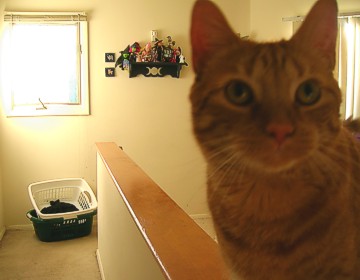
In order to get a picture of wide open beautiful kitty eyes, I need bright sunlight, because the flash makes ’em squint. Hardly ever capture the right moment, so I’m delighted with this one.

I’m ready for my close-up, Mr. DeMille

» Read more..

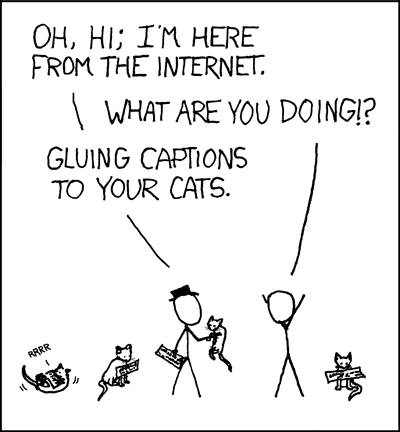
Ultimate Lolcats Commentary

From xkcd

Oh hai

Things Witches Say

There’s wax on the cat.

September 11, 2007

As I listen to the radio this morning, I am reminded of the date. And the more I listen, the more it becomes clear: No one knows what to say.

Arthur’s school calendar has today marked as “The Day We Will Never Forget.” Okay. If we’ll never forget, why do we have to mark it? There’s something so self-serving, so bombastic, about the statement. Never forgetting is internal, but marking the calendar with a big Twin Towers graphic overlaid by those word says “We’ll never forget motherfucker.”

And certainly rage is as appropriate a reaction as sorrow (which is where I tend to live with it), but graphic arts bombast I can do without.

We have been abused and taken advantage of by our government. Our love of country has been manipulated, our grief has been played like a violin. Osama bin Laden is still free and our troops were prevented from capturing him, and no one who actually had anything to do with the attacks of September 11 has been brought to justice. More American troops have died in Iraq, a war cynically sold to us as having ‘something’ to do with September 11, than actually died on September 11, 2001.

Our civil liberties have been eroded past the point of horror in the name of fighting back, and yet, we have not really fought back. There is no evidence that the PATRIOT Act or the illegal wiretappings have captured any terrorists.

The city of New York itself has been treated with cynicism and gross disregard. Respiratory disease among clean-up workers is rampant. Giuliani bears a great deal of blame for refusing to allow OSHA to run the safety show at Ground Zero, while the federal government is accountable for a false EPA report declaring the area safe, and yanking away money promised to survivors and rescuers.

And I could go on.

So today’s memorials focus on grief, because the rage that once was directed at bin Laden alone is now directed inward, towards our own government, and that is unbearable.

And about grief, there is so little to say.

Monday Movie Review: Man of the West

Man of the West (1958) 10/10
Link Jones (Gary Cooper) takes the train to El Paso to hire a schoolteacher for his homesteading community. But when the train is robbed and Link and fellow passengers Billie Ellis (Julie London) and Sam Beasley (Arthur O’Connell) are stranded, Link leads them to his old home, where he confronts his outlaw past in the form of his uncle (Lee J. Cobb) and the rest of the gang who robbed the train. Directed by Anthony Mann.

The conventional wisdom is that Sergio Leone launched a new kind of Western with A Fistful of Dollars and his subsequent “Spaghetti Westerns;” a dark, dirty Western of gritty violence, betrayal, and rape. But before Leone there was Anthony Mann and the “psychological Western.” Beginning in 1950 with Winchester ’73, Mann explored the psyche of men who were torn between the evil they had done and would do, and the goodness in their hearts. Most of these movies were made with Jimmy Stewart, but the last of them, Man of the West, was made with Gary Cooper.

I’ve seen three of the Stewart-Mann Westerns, and I’ve loved them all, but nothing prepared me for Man of the West, which was less reminiscent of Mann’s earlier movies than it was prescient of Leone’s. I mean there’s dark, and then there’s dark.

Or, to put it another way, Man of the West blew my mind.

Link Jones, brilliantly played by Cooper, is a complex man, overwhelmed by the longings and fears within, so much that he is not so much silent by nature as driven to silence, forced there by his frequent inability to voice a simple truth; his truths are all so complex. At first he seems awkward, almost goofy, but gradually we understand he is nervous and struggling with self-restraint. He carries to El Paso all the money that all his fellow homesteaders have saved to hire a schoolteacher (who will require a year’s salary in advance in order to relocate to such a remote settlement). He is nervous with the money—too nervous; the inside man on the train job takes notice—and then he is despondent when it is taken. With nowhere to go, he returns to the home he abandoned long ago, but the train robbers have beaten him there. He and his companions are taken prisoner, and the rest of the movie is played out as a tense hostage situation. Can Link free his fellow passengers? Can he avoid returning to the life of crime he despises?

The tension is brilliantly drawn, and the ugliness of the crooks (Cobb, Jack Lord, and John Dehner chief among them) is stunning. There’s a brilliant scene where the bad guys try to force Billie to strip for them. Brilliant in the sense of disturbing, frightening, even nauseating. In a sense, this scene epitomizes everything that’s great about this movie. Link is heroic but ineffectual. The bad guys are crude, nasty, and without limits. Billie is a real woman, not “the woman,” and her humiliation is all the more real for it. The whole thing is startling.

And it just keeps up like that. Link trying to think his way out, and the rest, very aware that’s exactly what he’s doing, but needing to keep him alive anyway, thwart him at every turn.

If you’ve been keeping up with my reviews, you know I’ve been on a Western kick for a while, maybe a year now. I don’t know why I’ve never heard of this one before, why so many other Westerns are more famous, and this masterpiece is collecting metaphorical dust.

Madeline L’Engle

Madeline L’Engle has died at the age of 88.

A Wrinkle In Time was one of my go-to books as a kid, I read it over and over. Despite my notable memory problems, I remember large chunks of the book. I still find the explanation of a tesseract, as the ends of cloth meeting one another, incomparably useful.

Madeline L’Engle brought me wonderful characters, extraordinary ideas, and concepts of science and philosophy that didn’t talk down to a young mind. To me, she will live forever.

Friday Catblogging: Return of Kittenblogging

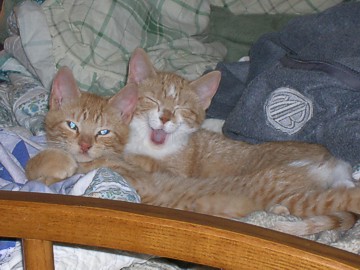
I was cleaning my files and I found this beauty from January of ’06 (which is about when I figured out how to upload photos from my new camera). My little darlings would have been 3 months old in this shot. Ah, memories. Ain’t they cuties?

This photo has never appeared on the site. There were so many cute kitten pictures from around this age, it didn’t make the cut.

So here it is!

Big Yawn, Little Kitty