Archive for Deborah Lipp

A little more about Juno

Apparently, Juno is all controversial. It’s unkind to people who were adopted as well as to birth mothers to create a comedy about adoption. There’s a lot of discussion about whether Juno is anti-choice.

Shut! Up!

This is where I part ways with many feminists and other activists; where they start criticizing or trying to restrict art based on content. It’s not better to object to a movie based on its supposed anti-choice values than it is to object to a movie based on its supposed liberal values. It all feels like Social Realism thinking to me. I get that a birth mother might not want to see Juno, and might find it painful. And I sympathize. But that doesn’t mean that the subject matter should be off-limits. There are definitely things I never want to see in movies, and movies I avoid as a result. Comedies that everyone loves that I’ve never seen because they feel like they would trigger some serious pain for me.

But that doesn’t mean those comedies shouldn’t be made, nor that they are “not funny” by some objective standard. There is no objectivity with humor.

The more touchy the subject, the harder to do it right. One of my problems with Waitress, which was basically very charming, was the attempt to have a humorous abusive husband. This wasn’t triggering for me; I’ve never been the victim of domestic violence, but it made me uncomfortable.

I didn’t come away from that movie thinking this subject should never be addressed in a comedy. I came away thinking that maybe it can’t be done well, and this movie definitely didn’t do it well. But who knows? If beautifully written and acted, maybe it could illuminate the characters without feeling way out of line. Maybe.

If so, some people will choose to skip that movie anyway, because it hurts too much, and it’s not funny for them. I get that. I just don’t feel like it should be censored in advance, and I don’t feel that people who do find it funny should be accused of being less enlightened or feminist or socially responsible than thou.

D Trivia: All Solved

Great job, everyone.

» Read more..

Men’s Figure Skating: Holy Mother of God!

If you follow figure skating, you probably already know this. If you just watch the Olympics every four years, not so much. I follow the Nationals and such when I can, but not avidly. I love it but I make little time in my life for sports.

So the U.S. Figure Skating Nationals were this weekend. I watched part on Saturday and DVRed the rest. I watched the rest of Saturday (dance and women’s) on Sunday and Sunday (men’s) last night.

Holy shit.

The two top American male skaters were both in the last Winter Olympics, so if you’re an every-four-years fan, you may remember them; they are Johnny Weir and Evan Lysacek. They could not be more opposite. Weir is small, artsy, and fey. He performs complex choreography laden with symbolism, and wears weird sparkly costumes that are also symbolic. When he skates well, he has ease and grace and you feel centered just to watch him. Often enough, he skates poorly or inconsistently, like a brat, and he has called himself a “princess” and a “bitch.”

Lysacek is tall and masculine. His costumes are of the pants-and-shirt variety. Men’s skating is very gay, and Lysacek probably is as well (although, y’know, we haven’t dated) but he’s kind of a top. His skating is dramatic and forceful, with straightline footwork that feels like you’ve been attacked by a mad flamenco dancer. But in a good way. He’s a balls-to-the-wall skater who pulled out a fab long program in Turino after a round of IV fluids.

So naturally, NBC was playing up the rivalry between the two. And even though the reporters are dorky, the competition was thrilling and the skating quality was amazing.

And then something happened I’ve never seen: Something no one has ever seen.

Weir and Lysacek tied.

Tied.

Each earned exactly 244.77 points. Lysacek got the gold, because the rule book says that in a tie, the higher-scoring long program wins. I have no idea what happens if both individual skates tie!

Tied.

The two athletes were stunned. They didn’t know how to take it. And I, who disdain most sports, started screaming Oh! My! God! rather loudly.

Oh. My. God.

Tuesday Trivia: Movies Beginning with the letter D

Because I feel like it.

1. The scientists decide the cafe owner is okay because she refuses to keep coffee in the freezer.
Solved by Ken (comment #12).

2. A character in this movie has rings that mimic tattoos from a 1955 movie. These tattoos are also mimicked in a 1975 movie.
Solved by Melville (comment #1).

3. “I don’t think you fully understand, _______. You’ve been murdered.”
Solved by Evn (comment #11).

4. Person 1: “So what country do you want to go to?”
Person 2: “Wyoming.”
Person 1: “___, Wyoming’s not a country.”
Solved by Melville (comment #1).

5. Based on a famous book with a cult following and numerous sequels. Critically-acclaimed director. Rock star as one of the villains. Bad movie.
Solved by Roberta (comment #3).

6. “I never gave a ticket to a nun before. I gave a ticket to a guy from the IRS one time.”
Solved by Anthony Cartouche (comment #10).

7. Neither Humphrey Bogart nor Ronald Reagan get the girl.
Solved by Melville (comment #1).

I am 75% addicted to blogging

75%How Addicted to Blogging Are You?

Monday Movie Review: Juno

Juno (2007) 10/10
Juno (Ellen Page) is sixteen and pregnant. After seeking an abortion and then changing her mind, she decides to give her baby up for adoption.

Everything about Juno works. The strong individuality of the characters; quirky but not full-blown oddball, the honesty and frankness of the reality it presents, the acting, the mise-en-scène, all of it. Juno is about people who are flawed and unique; there isn’t an emblematic role in the group. Jennifer Garner isn’t The Uptight Yuppie, and Allison Janney isn’t The Stepmother; they’re all people, and they’re all worth paying attention to.

The script is well-written, but what kept me laughing was exquisite delivery and timing. J.K. Simmons as Juno’s dad keeps pitching his lines underhanded and soft, so you don’t think much of them, and then wham! The landing. “Hey, Dad.” “Hey, big puffy version of Junebug.”

But let’s get back to the frankness for a moment. I’d classify this movie as sex-positive, remarkably so nowadays. Juno is direct about her sexuality; she had sex and she got pregnant. She is confused about the sex but she enjoyed it. She is confused about the boy but she enjoys him. She isn’t ashamed and she never allows her predicament to negate that. Her parents are unhappy about what’s happened, but they stick by her and help her and don’t hang a scarlet letter around her chest. The language is direct and real. She isn’t “in trouble,” she’s pregnant. She isn’t calling to “handle it” she wants “a hasty abortion.” At the abortion clinic, the very funny girl at the front desk recommends she takes free condoms and is enthusiastic about their use.

But none of this is preaching. This is actually how people talk. In movies, people say “shmuh-shmortion” but in real life, people say the real words, and everyone knows, or should know, that sex happens, even when you’re only sixteen. Juno affects a wise-beyond-her-years routine that’s been working for her until now, and she’s not dropping it just because she’s in over her head.

And all of this sounds like some kind of life lesson, but the best thing about Juno goes back to my first paragraph; it’s a movie about individuals, not about Big Lessons or Symbolic Characters. No one is on-screen to represent a particular choice, they’re all there to be themselves, thankyouverymuch. They all make mistakes, and they all struggle to make fewer mistakes next time.

Yes, it gets touching. It kind of has to. And I shed tears. But it’s not corny. Or too predictable. And none of our characters give up being themselves in order to tidy up the ending. For which I, and any other frequent movie-goer, has got to be incredibly grateful.

For all Juno’s charm and intelligence and humanity, I actually came away mostly with the pleasure of a good laugh that wasn’t mean-spirited or stupid, that celebrated its characters rather than mocked them, and that made me enjoy the act of being there laughing with them.

I haven’t seen the other four nominated Best Pictures, but I’m glad Juno is among them.

Sunday Meditation: Meditation and Prayer

Perhaps you think of meditation and prayer as two entirely different things; many people do. Indeed, meditation can be an entirely secular activity, or it can be spiritual, but unrelated to the worship of a specific deity. Meditation is a discipline of mind, focusing awareness, thoughts, emotions, or state of being in a particular way. Prayer, on the other hand, is communion with deity (God or a god or gods).

Prayer can take many forms. It can be supplication, thanksgiving, acknowledgment, or simply being in the presence of deity in a worshipful way. Most Western religions don’t have a specific tradition of meditation; instead, prayer is where meditation happens. To be in the presence of deity and still the mind in order to commune with deity, to receive wisdom or comfort or peace; this is meditation. It’s explicit in things like Quaker meetings, but implicit, perhaps in different language, in many practices of Christianity, Judaism, and Islam.

But this is a Pagan site, and so let’s talk about this in a Pagan way. My plan is to discuss the relationship between Pagan prayer and meditation today, and in the coming weeks, use the Sunday Meditation space to talk about specific aspects of that, like the use of home altars and so on. I’d welcome suggestions in comments about any specific topics you’d like to see.

First let’s talk about the mind in prayer. Assuming the intention of prayer is to speak with or commune with the gods in some way, then it would certainly help to be in a meditative state first. So there’s two ways of approaching this.

Method 1: Pray.

Method 2: Still the mind. Ground and center. Pray.

Now, right on the face of it, you can see that Method 2 is going to work better, and by “work” I mean “produce the desired result,” i.e. achieving a sense of communion with deity.

You can also prepare to pray in much the same way you prepare to meditate, and for the same reasons:

Phone rings while meditating, concentration broken: Bad.

Phone rings while praying, feeling of connection to deity broken: Bad.

So, preparing to meditate and preparing to pray are not that different. You want to take a little space, a little moment where you’re not interrupted. (On a future Sunday, I’m going to discuss small moments of meditation/prayer and how to find them in a busy life. This is super helpful if you’re the mother of an infant, for example.)

Use of a dedicated spot—an altar—for prayer or worship is actually more common than using such a spot for meditation, but I do it for both, and I do it specifically because it works. There’s a number of things a dedicated spot can achieve; it provides visual cues that help still the mind. Being there triggers a kind of post-hypnotic suggestion, indicating to the mind that it’s time to enter into a meditative state. Things you use during meditation or prayer (rosary beads, candles, incense) are all in a convenient spot, so there’s no fussing about.

I meditate at my altar, and I don’t always make much distinction between prayer or meditation. I’m stilling my mind in the presence of my Goddess. Or I’m stilling my mind in order to be in the presence of my Goddess. Whatever. These distinctions: Prayer, worship, meditation, communion; they’re for the intellect, they’re for thinking about afterwards. In the act, in the moment, it doesn’t matter what you call it, it’s simply what you do that enriches your life and brings peace.

Advice to the seeker

Cosette has posted a wonderful blog entitled “Open Letter to a Seeker.” It condenses a whole lot of good, gentle, helpful information for the Pagan seeker, all in one place. Please read it.

Friday Catblogging: We don’t do this anymore

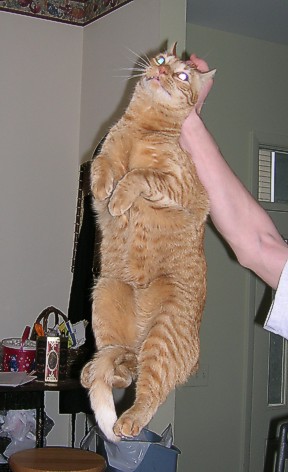
I am not sure how we started picking Mingo up in strange ways. Like this. But he loved it. Loved it. And begged for it. And actually, still begs for it. But it seemed really weird and creepy so we asked the vet and she said don’t do it. So we don’t.

But it makes for a wild photo.

Hangin’ around

A.O. Scott’s tender and intelligent obituary of Heath Ledger

In today’s New York Times. Probably the best thing to read as an antitode to creepy and cruel speculation, but not an antitode to grief. An excerpt:

The dismaying sense of loss and waste at Mr. Ledger’s death at 28 comes not only because he was so young, but also because his talent was large and as yet largely unmapped. It seems inevitable that he will now be inscribed in the cult of the beautiful stars who died too young, alongside James Dean, Montgomery Clift and Marilyn Monroe. Even before his death he had been ensnared in a pathological gossip culture that chews up the private lives of celebrities, and Tuesday’s news unleashed the usual rituals of media cannibalism.

Mr. Ledger’s work will outlast the frenzy. But there should have been more. Instead of being preserved as a young star eclipsed in his prime, he should have had time to outgrow his early promise and become the strange, surprising, era-defining actor he always had the potential to be.